Infectious Disease Attending Visit
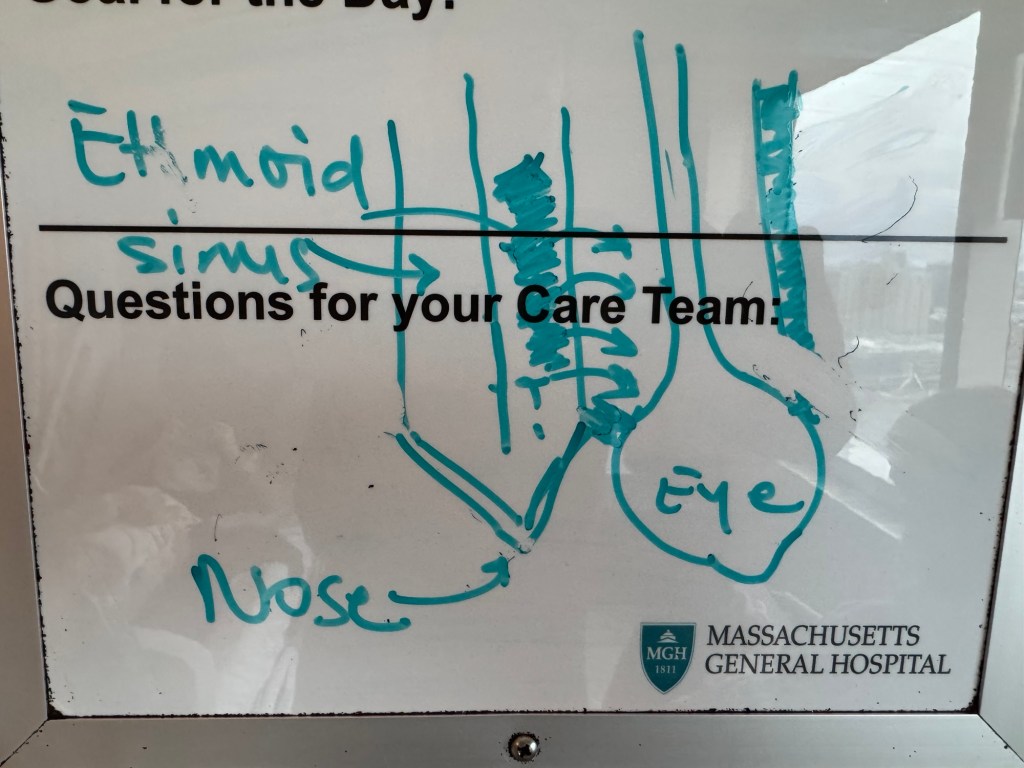
The infectious disease attending came by for an extended visit this morning, spending considerable time with Chase. He took time to explain the full picture clearly, including drawing diagrams to help Chase understand exactly what has been happening inside his head this past week.
Chase’s Current Status:
Chase reported that his pain has decreased significantly. The pain above his eyebrow that started this whole journey is essentially gone. Some discomfort remains around the eye but only when it is being examined or pressed during medical exams — not spontaneously. Eye movement is intact and pain free. The team noted some swelling has returned since the drain was removed last night, which is being monitored closely.
What Happened:
The attending took time to draw out the anatomy and explain exactly how Chase ended up with two simultaneous and serious complications from what began as a sinus infection. The key points:
There is an extremely thin bone — called the lamina papyracea, meaning literally “paper thin bone” — that separates the ethmoid sinus from the space behind the eye. Bacteria from Chase’s sinus infection crossed through this bone into the orbital space behind the eye. Because the orbit is essentially a closed pyramid shaped space with nowhere to expand except toward the brain, pressure built rapidly — threatening the optic nerve and vision. This is what drove the emergency eye surgery on Friday.
Simultaneously the frontal sinus infection pushed forward through the forehead causing the external swelling and abscess — the Pott’s Puffy Tumor presentation. The attending noted that seeing both complications together is unusual. Typically they present separately. Chase managed both at once.
What The Team Is Focused On Now:
The sinus and forehead situation is essentially resolved. The attending was clear, if it were not for the eye, Chase would likely already be home. The focus has now shifted entirely to the eye and orbit. The inflammation behind the eye is small in volume but its location, adjacent to the optic nerve and close to the brain, means it requires careful and ongoing monitoring. The team will not rush any decisions.
Cultures and the Unknown Organism:
The cultures collected during surgery have shown some bacterial growth but nothing definitive enough to identify a specific organism. The heavy antibiotic exposure prior to surgery made clean culture results difficult to obtain. Because Chase is responding well the team sees no reason to change the current antibiotic regimen.
Antibiotic Plan Going Forward:
The attending is not yet ready to make the call on IV versus oral antibiotics at home. The decision will depend on how Chase’s eye continues to respond over the next several days.
Two scenarios:
• If the eye continues to show signs of active infection and the team needs to consider returning to the operating room — IV antibiotics will continue and a PICC line for home use becomes more likely
• If this is the tail end of the infection and the eye continues to improve — a transition to oral antibiotics becomes possible
How They Will Know When Chase Is Ready to Go Home:
The attending outlined the key markers they are watching:
• Inflammatory blood markers — CRP and white blood cell count — continuing to trend downward. The CRP has already dropped dramatically from over 100 to 37, which is very encouraging
• No fever — Chase has largely avoided significant fever throughout which has been a good sign
• Ocular pressure, eye movement, and vision remaining stable or improving
• Overall how Chase looks and feels
The Bottom Line:
The antibiotics are doing their job. The surgical interventions achieved good source control. The numbers are moving in the right direction. The remaining focus is protecting Chase’s eye and vision over the coming days. The attending was reassuring but underscored that this is not a situation where anyone will rush outcomes. Day to day.
 How’s Chase?